sqlite-xsv
A fast and performant SQLite extension for CSV files, written in Rust! Based on sqlite-loadable-rs and the wonderful csv crate.
- Query CSVs, TSVs, and other-SVs as SQLite virtual tables
- The "reader" interface lets you query CSVs from other data sources, such as
sqlite-http - Builtin support for querying CSVs with gzip or zstd compression
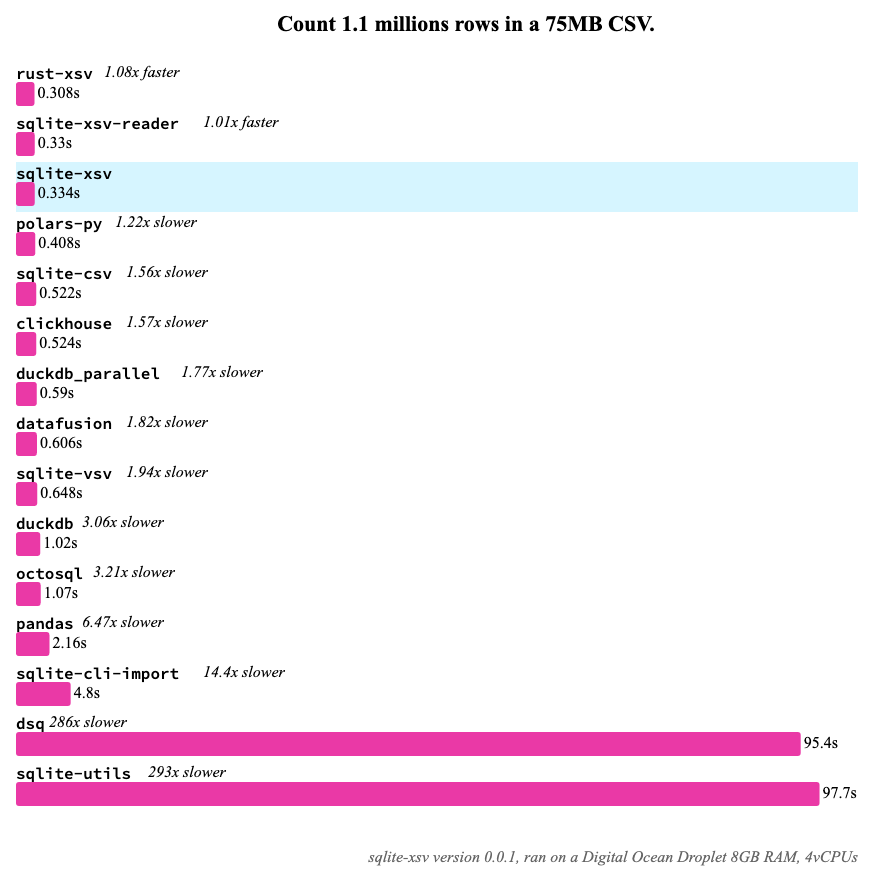
See Introducing sqlite-xsv: The Fastest CSV Parser for SQLite (Jan 2023) for more details!
Note Nothing to do with xsv, but is based on the same csv crate. This is named
sqlite-xsvto distinguish between the official SQLite CSV Virtual table and thesqleanvsv extension.
Usage
.load ./xsv0

create virtual table temp.students using csv(
  filename="students.csv"
);

select * from temp.students;
/*
┌────┬───────┬─────┬─────────┐
│ id │ name  │ age │ process │
├────┼───────┼─────┼─────────┤
│ 1  │ alex  │ 10  │ .9      │
│ 2  │ brian │ 20  │ .7      │
│ 3  │ craig │ 30  │ .3      │
└────┴───────┴─────┴─────────┘
*/
Provide a schema for CSVs that lack headers, or to provide types on columns.
create virtual table temp.students_no_header using csv(
  filename="students_no_header.csv",
  header=false,
  id text,
  name text,
  age int,
);

select * from temp.students_no_header;
Query files that are gzip'ed or compressed with zstd directly.
create virtual table temp.students_gz using csv(
  filename="students.csv.gz"
);

select * from temp.students_gz;


create virtual table temp.students_zst using csv(
  filename="students.csv.zst"
);

select * from temp.students_zst;
Use the csv_reader API and the fsdir() function in the SQLite CLI to read from several CSV files in one query.
create virtual table temp.students_reader using csv_reader(
  id integer,
  name text,
  age integer,
  progess real
);

with files as (
   select name as path
   from fsdir('tests/data/student_files')

)
select
  files.path,
  students.*
from files
join students_reader(files.path) as students
where files.path like '%.csv';
/*
┌────────────────────────────────┬────┬───────────┬─────┬─────────┐
│              path              │ id │   name    │ age │ progess │
├────────────────────────────────┼────┼───────────┼─────┼─────────┤
│ tests/data/student_files/a.csv │ 1  │ alex      │ 10  │ 0.9     │
│ tests/data/student_files/a.csv │ 2  │ adrian    │ 20  │ 0.8     │
│ tests/data/student_files/a.csv │ 3  │ andres    │ 30  │ 0.7     │
│ tests/data/student_files/c.csv │ 1  │ craig     │ 70  │ 0.4     │
│ tests/data/student_files/c.csv │ 2  │ catherine │ 90  │ 0.5     │
│ tests/data/student_files/c.csv │ 3  │ coin      │ 80  │ 0.6     │
│ tests/data/student_files/b.csv │ 1  │ brian     │ 60  │ 0.1     │
│ tests/data/student_files/b.csv │ 2  │ beto      │ 50  │ 0.2     │
│ tests/data/student_files/b.csv │ 3  │ brandy    │ 40  │ 0.3     │
└────────────────────────────────┴────┴───────────┴─────┴─────────┘
*/
Query CSVs from HTTP endpoints, with the reader API and sqlite-http. Note: Only works for CSVs that work in memory, for now.
.load ./http0
-- Reading a CSV from the wonderful LA Times COVID project
-- https://github.com/datadesk/california-coronavirus-data

create virtual table temp.cdph_age_reader using csv_reader(
  date,
  age text,
  confirmed_cases_total int,
  confirmed_cases_percent float,
  deaths_total int,
  deaths_percent float
);

create table cdph_age as
  select *
  from temp.cdph_age_reader(
    http_get_body(
      'https://raw.githubusercontent.com/datadesk/california-coronavirus-data/master/cdph-age.csv'
    )
  );

select *
from cdph_age
limit 5;

/*
┌────────────┬───────┬───────────────────────┬─────────────────────────┬──────────────┬────────────────┐
│    date    │  age  │ confirmed_cases_total │ confirmed_cases_percent │ deaths_total │ deaths_percent │
├────────────┼───────┼───────────────────────┼─────────────────────────┼──────────────┼────────────────┤
│ 2023-01-03 │ 0-4   │ 371691                │ 0.034                   │ 32           │ 0.0            │
│ 2023-01-03 │ 80+   │ 292252                │ 0.027                   │ 37038        │ 0.378          │
│ 2023-01-03 │ 18–34 │ 3416056               │ 0.312                   │ 1655         │ 0.017          │
│ 2023-01-03 │ 35–49 │ 2530259               │ 0.231                   │ 6135         │ 0.063          │
│ 2023-01-03 │ 50–59 │ 1379087               │ 0.126                   │ 10892        │ 0.111          │
└────────────┴───────┴───────────────────────┴─────────────────────────┴──────────────┴────────────────┘
*/
Documentation
See docs.md for a full API reference.
Installing
| Language | Install | |
|---|---|---|
| Python | pip install sqlite-xsv |
 |
| Node.js | npm install sqlite-xsv |
 |
| Deno | deno.land/x/sqlite_xsv |
 |
| Ruby | gem install sqlite-xsv |
 |
| Rust | cargo add sqlite-xsv |
 |
| Github Release |  |
The Releases page contains pre-built binaries for Linux amd64, MacOS amd64 (no arm yet), and Windows.
As a loadable extension
If you want to use sqlite-xsv as a Runtime-loadable extension, Download the xsv0.dylib (for MacOS), xsv0.so (Linux), or xsv0.dll (Windows) file from a release and load it into your SQLite environment.
Note: The
0in the filename (xsv0.dylib/xsv0.so/xsv0.dll) denotes the major version ofsqlite-xsv. Currentlysqlite-xsvis pre v1, so expect breaking changes in future versions.
For example, if you are using the SQLite CLI, you can load the library like so:
.load ./xsv0
select xsv_version();
-- v0.0.1
Or in Python, using the builtin sqlite3 module:
import sqlite3

con = sqlite3.connect(":memory:")

con.enable_load_extension(True)
con.load_extension("./xsv0")

print(con.execute("select xsv_version()").fetchone())
# ('v0.0.1',)
Or in Node.js using better-sqlite3:
const Database = require("better-sqlite3");
const db = new Database(":memory:");

db.loadExtension("./xsv0");

console.log(db.prepare("select xsv_version()").get());
// { 'xsv_version()': 'v0.0.1' }
For Datasette, it is currently NOT recommended to load sqlite-xsv in public Datasette instances. This is because the SQL API reads files from the filesystem, which is dangerous on Datasette instances. This may be changed in future version of `sqlite-xsv.
